
The Spotlight Effect
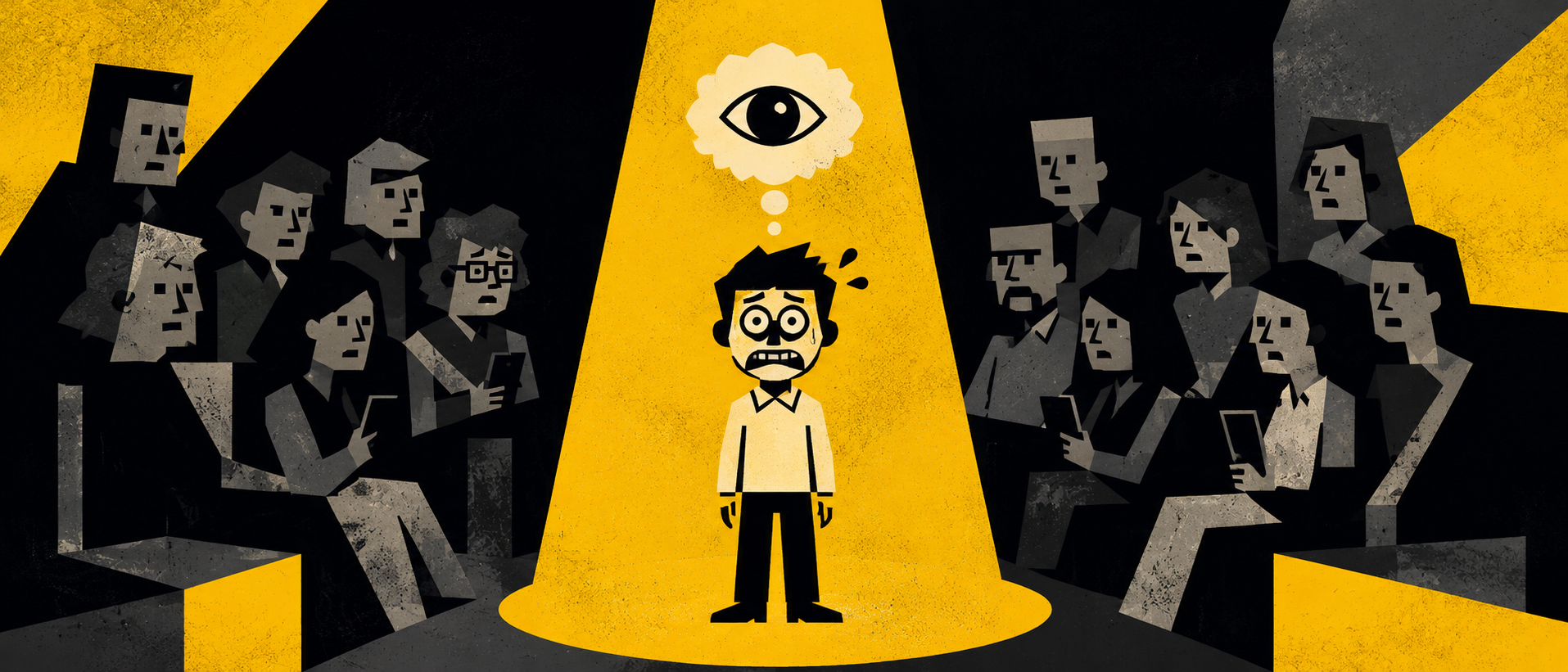
The crushing delusion that other people are paying far more attention to your appearance, behavior, and mistakes than they actually are.
THE TRAP TEST
1 / 5You spill a drop of coffee on your shirt right before a major presentation. You assume:
👇 Choose one option:
The Anchoring of the Ego
We are the center of our own universe. Because we are anchored to our own sensory experience—feeling our own anxiety, seeing our own stained shirt, hearing our own stutter—we assume this internal volume matches the external broadcast. We fail to adjust for the fact that everyone else is similarly anchored in their own heads, obsessing over their own perceived flaws. You are a background extra in almost everyone else's movie.
The Barry Manilow Humiliation Study
Psychologist Thomas Gilovich forced college students to wear an embarrassing Barry Manilow t-shirt into a room full of peers. The students estimated that at least 50% of the room would notice the embarrassing shirt and judge them. The reality? Less than 20% even registered the shirt. In the corporate world, this effect kills innovation: executives frequently withhold game-changing ideas or refuse to pivot failing strategies because they drastically overestimate the social penalty of being wrong in public.
How to Exploit Your Invisibility
The 10% Rule
Whatever amount of attention you think people are paying to your mistake, divide it by 10. That is closer to reality.
Externalize Your Focus
When feeling self-conscious, force your brain to focus outward. Look at the people in the room. What are they actually doing? You'll quickly realize they are looking at their phones, not at you.
The 'So What' Protocol
Even if someone does notice your mistake, ask yourself: 'So what?' Will this matter in a week? A month? The half-life of public judgment is vanishingly short.