
Loss Aversion
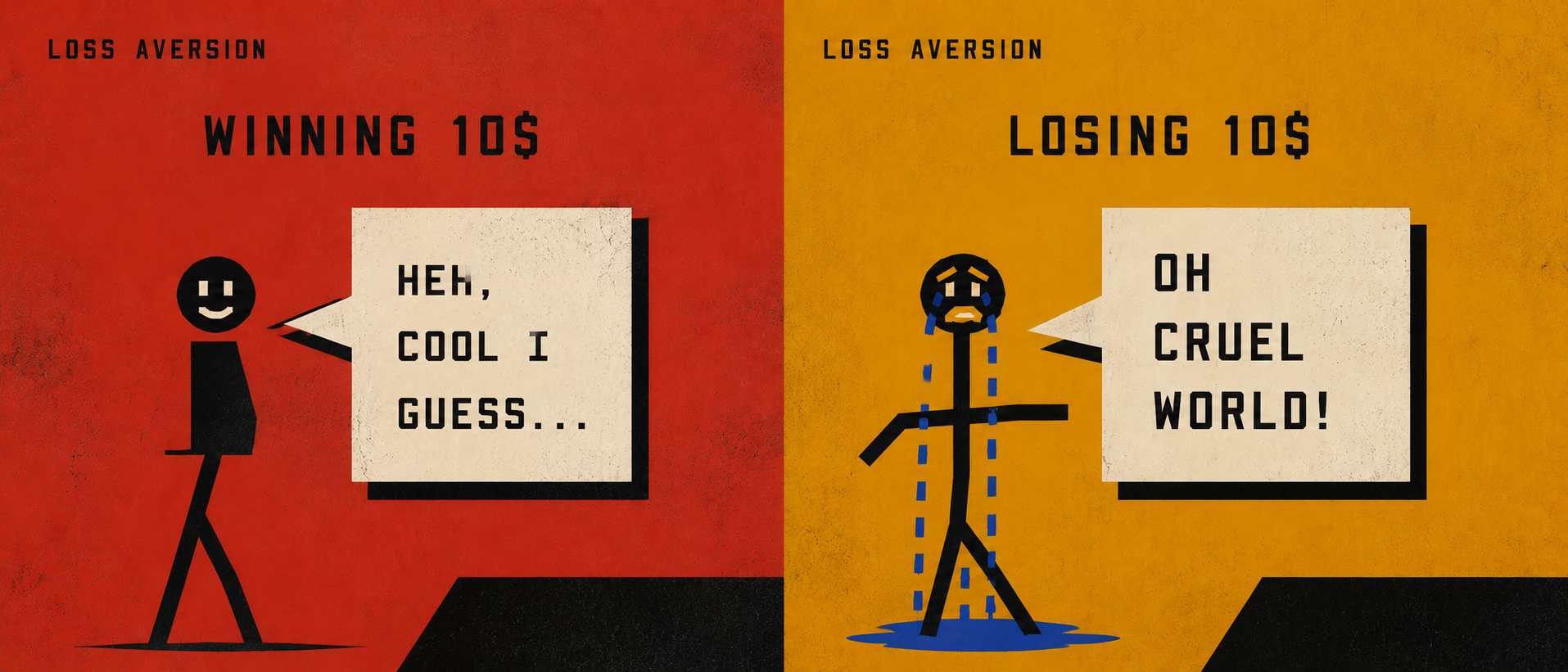
The evolutionary glitch where the pain of losing is psychologically twice as powerful as the pleasure of gaining. You will risk total devastation just to avoid taking a minor, guaranteed loss.
THE TRAP TEST
1 / 5You bought a stock at $50. It's now at $20 and the company is failing.
👇 Choose one option:
The Asymmetry of Pain
From an evolutionary perspective, passing up a chance to find food (a missed gain) meant you might go hungry. But losing the food you already had (a loss) meant you might starve to death. The brain's threat-detection center, the amygdala, processes losses as existential threats. Consequently, psychological studies show that losing $1,000 generates a negative emotional response that is roughly twice as intense as the positive joy of winning $1,000. This glitch makes humans irrationally conservative in the face of gains, and recklessly risky when trying to avoid losses.
The Man Who Broke Barings Bank
In 1995, a rogue trader named Nick Leeson single-handedly bankrupted Barings Bank, a 233-year-old financial institution. It started with a small trading loss. Instead of reporting it and taking the hit, Leeson's Loss Aversion kicked in. He hid the loss in a secret error account (the infamous 88888 account) and started making massive, unauthorized, highly leveraged bets to win the money back. As the losses compounded, he doubled down again and again, unable to accept the reality of the initial deficit. By the time he fled, he had lost $1.4 billion, erasing the entire bank.
The Sunk Cost Severance
The Clean Slate Metric
When evaluating a losing position (financial or emotional), ask: 'If I had my money/time back in cash right now, would I buy into this exact situation?' If no, exit.
Pre-Define the Exit
Before entering any trade, project, or relationship, write down your hard exit conditions. When the metric hits, you execute the exit flawlessly, without emotion.
Flip the Frame
When facing a loss, reframe it. You aren't 'losing' $20 on a bad movie; you are 'buying' two hours of your freedom back. Make the exit feel like a gain.