The Barnum Effect
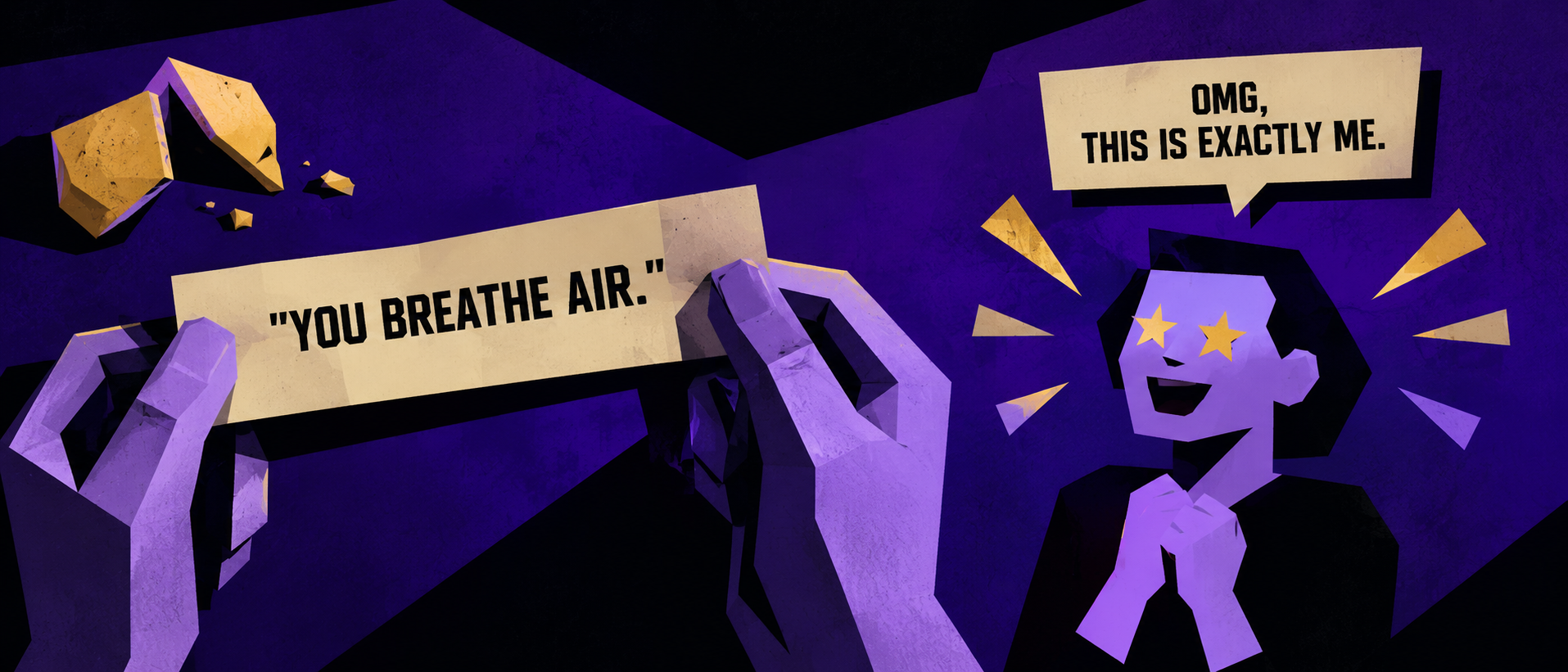
The psychological glitch that makes you believe highly generic, universally applicable personality descriptions were tailored specifically for you.
THE TRAP TEST
1 / 5You take a corporate personality test that concludes: 'You have a great deal of unused capacity which you have not turned to your advantage.' You think:
👇 Choose one option:
The Anatomy of Vanity
The Barnum Effect (or Forer Effect) operates on two massive cognitive flaws: vanity and confirmation bias. We desperately want to feel seen and unique. When presented with a flattering or vaguely empathetic statement, our brain immediately scans our memory for evidence that confirms it, ignoring all evidence to the contrary. We do the heavy lifting of making the generic statement specific to our lives.
The Multibillion-Dollar Personality Lie
The Myers-Briggs Type Indicator (MBTI) generates over $20 million annually and is used by 89 of the Fortune 100 companies. Yet, psychologically, it is widely considered pseudoscience. Its vague, flattering categorizations rely heavily on the Barnum Effect to make executives feel 'understood.' Corporations have restructured teams, fired employees, and shaped entire cultures based on generalized horoscopes masquerading as psychometrics, wasting billions of dollars on an illusion of insight.
How to Defend Against Flattery
The Inverse Test
When reading a description of yourself, ask: 'Would anyone actually agree with the opposite of this statement?' If no one would claim to be 'completely devoid of potential' or 'blindly accepting of everything,' the original statement is useless.
Strip the Ego
Assume any assessment that is overly flattering is trying to sell you something—either a product, an ideology, or an agenda.
Demand Granularity
Ignore descriptions. Demand predictions. A valid assessment doesn't just describe your 'traits'; it accurately predicts your behavior in highly specific, falsifiable scenarios.